Pages

Showing posts with label 'Military Insignia & Heraldry’ by Serge Averbukh. Show all posts

Saturday, February 22, 2020

United States Space Force - USSF


The United States Space Force (USSF) is the space operations service branch of the United States Armed Forces, and is one of the eight U.S. uniformed services. The sixth and youngest branch of the U.S. Armed Forces, it was the first branch of the military established since the formation of the independent U.S. Air Force in 1947. The antecedent of the Space Force, Air Force Space Command, a major command of the U.S. Air Force, was formed on 1 September 1982 with responsibility for space warfare operations. The National Defense Authorization Act for 2020 redesignated Air Force Space Command as the U.S. Space Force, and established it as an independent branch of the U.S. Armed Forces on 20 December 2019.

The U.S. Space Force is organized as a military service branch within the Department of the Air Force, one of the three military departments within the Department of Defense. The Space Force, through the Department of the Air Force, is headed by the Secretary of the Air Force, who reports to the Secretary of Defense, and is appointed by the President with Senate confirmation. In terms of personnel count, it is the smallest U.S. armed service within the U.S. Department of Defense.

The most senior Space Force officer is the Chief of Space Operations, unless a Space Force officer also serves as either the chairman or vice chairman of the Joint Chiefs of Staff. The Chief of Space Operations exercises supervision over the Space Force's units and serves as one of the Joint Chiefs of Staff. Certain Space Force components will be assigned, as directed by the Secretary of Defense and Secretary of the Air Force, to unified combatant commands. Combatant commanders will be delegated operational authority of the forces assigned to them, while the Secretary of the Air Force and the Chief of Space Operations will retain administrative authority over their members.

As always, the above artworks are available via my “Military Insignia” galleries from FineArt America and RedBubble.


To active duty or reserve military personnel, veterans and their family members: I grant an explicit permission to download the above images to be used for non-profit/non-commercial and charitable causes, benefiting troops and their families, as well as for non-commercial internal duty-specific purposes, such as unit website design, training materials and presentations. 

The above information provided in part by Wikipedia, The Institute of Heraldry, Global Security, and the official websites of the corresponding units and formations.

Wednesday, April 3, 2019

United States Military Academy (USMA) West Point

 
The United States Military Academy (USMA), also known as West Point, Army, Army West Point, The Academy, or simply The Point, is a four-year federal service academy in West Point, New York. It was originally established as a fort that sits on strategic high ground overlooking the Hudson River with a scenic view, 50 miles (80 km) north of New York City. It is one of the five U.S. service academies.

The Academy traces its roots to 1801, when President Thomas Jefferson directed, shortly after his inauguration, that plans be set in motion to establish the United States Military Academy at West Point. The entire central campus is a national landmark and home to scores of historic sites, buildings, and monuments. The majority of the campus's Norman-style buildings are constructed from gray and black granite. The campus is a popular tourist destination, with a visitor center and the oldest museum in the United States Army.

Candidates for admission must both apply directly to the academy and receive a nomination, usually from a member of Congress or Delegate/Resident Commissioner in the case of Washington, D.C., Puerto Rico, Northern Mariana Islands, Guam, American Samoa, and the Virgin Islands. Other nomination sources include the President and Vice President of the United States. Students are officers-in-training and are referred to as "cadets" or collectively as the "United States Corps of Cadets" (USCC). Tuition for cadets is fully funded by the Army in exchange for an active duty service obligation upon graduation. Approximately 1,300 cadets enter the Academy each July, with about 1,000 cadets graduating.

The academic program grants a bachelor of science degree with a curriculum that grades cadets' performance upon a broad academic program, military leadership performance, and mandatory participation in competitive athletics. Cadets are required to adhere to the Cadet Honor Code, which states that "a cadet will not lie, cheat, steal, or tolerate those who do." The academy bases a cadet's leadership experience as a development of all three pillars of performance: academics, physical, and military.

Most graduates are commissioned as second lieutenants in the Army. Foreign cadets are commissioned into the armies of their home countries. Since 1959, cadets have also been eligible for an interservice commission, a commission in one of the other armed services, provided they meet that service's eligibility standards. Most years, a very small number of cadets do this.

The academy's traditions have influenced other institutions because of its age and unique mission. It was the first American college to have an accredited civil-engineering program and the first to have class rings, and its technical curriculum was a model for later engineering schools. West Point's student body has a unique rank structure and lexicon. All cadets reside on campus and dine together en masse on weekdays for breakfast and lunch. The academy fields fifteen men's and nine women's National Collegiate Athletic Association (NCAA) sports teams. Cadets compete in one sport every fall, winter, and spring season at the intramural, club, or intercollegiate level. Its football team was a national power in the early and mid-20th century, winning three national championships. Its alumni and students are collectively referred to as "The Long Gray Line" and its ranks include two Presidents of the United States (as well as the President of the Confederate States of America), presidents of Costa Rica, Nicaragua, and the Philippines, numerous famous generals, and seventy-six Medal of Honor recipients.

The above information provided in part by Wikipedia, The Institute of Heraldry, Global Security, and the official websites of the corresponding units and formations.

Saturday, December 8, 2018

Special Operations Joint Task Force - Afghanistan - NSOCC-A/SOJTF-A


United States Army Special Operations Forces - Afghanistan have been conducting operations since the fall of 2001. The SOF personnel have deployed from a number of U.S. special operations units (SEALs, Green Berets, MARSOC, etc.) and over time worked as part of several different SOF units in Afghanistan. Currently (mid-2016) almost all U.S. SOF units in Afghanistan fall under the command of the NATO Special Operations Component Command – Afghanistan / Special Operations Joint Task Force – Afghanistan. That is a long name for a military organization so most people just use the acronym of NSOCC-A / SOJTF-A. An even shortened version is NSOCC-A or SOJTF-A; depending on your nationality it seems.
NSOCC-A / SOJTF-A is under a United States commander – a Major General (two-star) position. The non-U.S. SOF units fall under the command of NSOCC-A. U.S. SOF come under SOJTF-A. The commander of SOJTF-A is also the commander of NSOCC-A; so he is dual-hatted. He reports to the commander of the Resolute Support Mission – a U.S. four-star general.
The mission of Special Operations Forces – Afghanistan is to conduct “. . . Security Force Assistance and targeted Counter-Terrorism (CT) in Afghanistan to ensure the enduring relevance, proficiency, capability, and sustainability of the Afghan Special Security Force as a CT partner, and to deny safe haven to Al Qaeda and its affiliates and adherents.” 
The components of NSOCC-A / SOJTF-A include the Special Operations Task Force – Afghanistan (SOTF-A), a battalion-sized unit (usually U.S. Army Special Forces), Combined Joint Special Operations Aviation Component – Afghanistan (CJSOAC-A), General Command Police Special Units Special Operations Advisory Group (GCPSU SOAG), and a task force working the CT mission.
Special Operations Forces – Afghanistan are involved in the Train, Advise, and Assist (TAA) mission working with a number of Afghan SOF units. These include the Afghan National Army (ANA) Special Operations Kandaks, National Mission Units (NMU) of the Ministry of Interior, and the Afghan Air Force Special Mission Wing (SMW). U.S. SOF is also heavily involved in the advisory effort for the Afghan Local Police (ALP) – a village-focused security program sponsored by the Afghan Ministry of Interior.
In addition, there are a number of advisory teams working with the Ministry of Defense (MoD) and Ministry of Interior (MoI) as well as at the institutional level to improve the ability of the ministries and schoolhouses to support and sustain the Afghan SOF units of the army and police.


As always, artworks featuring the insignia are available via my “Military Insignia” galleries from FineArt America and RedBubble. 

To active duty or reserve military personnel, veterans and their family members: I grant an explicit permission to download the above images to be used for non-profit/non-commercial and charitable causes, benefiting troops and their families, as well as for non-commercial internal duty-specific purposes, such as unit website design, training materials and presentations.

The above information provided in part by Wikipedia, The Institute of Heraldry, Global Security, and the official websites of the corresponding units and formations.

Friday, September 21, 2018

75th Ranger Regiment


The 75th Ranger Regiment, also known as Army Rangers, is a light infantry airborne special operations force that is part of the United States Army Special Operations Command. The Regiment is headquartered at Fort Benning, Georgia and is composed of one special troops battalion and three Ranger battalions. The primary mission of the Regiment is to conduct direct action raids in hostile or sensitive environments worldwide, often killing or capturing high value targets.
The 75th Ranger Regiment is the U.S. Army's premier light infantry unit, with specialized skills that enable the Regiment to perform a variety of missions. Besides direct action raids, these include: Airfield seizure, special reconnaissance, personnel recovery, clandestine insertion, and site exploitation. The Regiment can deploy one Ranger battalion within 18 hours of alert notification.

The 1st Ranger Battalion, currently based at Hunter Army Airfield in Savannah, Georgia, United States, is the first of three ranger battalions belonging to the United States Army's 75th Ranger Regiment.
It was originally formed shortly after the United States' entry into World War II and was modeled after the British Commandos during the war. Members from the unit were the first American soldiers to see combat in the European theater when they participated in the failed raid on Dieppe in France in 1942, during which three Rangers were killed and several more were captured. Later, the 1st Ranger Battalion was sent to North Africa where they participated in the landings in Algeria and the fighting in Tunisia in 1943. Also in 1943 the unit provided cadre for two more Ranger battalions created between the campaigns in Sicily and Italy. After World War II, the 1st Ranger Battalion has gone through a number of changes of name and composition as it has been activated, deactivated and reorganized on a number of occasions. However, the unit has lived on in one form or another since then, serving in the Korean and Vietnam Wars before being consolidated into the 75th Ranger Regiment of which it is a part today. Recent deployments have included operations in both Iraq and Afghanistan as part of the wider global war on terrorism.

The 2nd Ranger Battalion, currently based at Joint Base Lewis-McChord south of Seattle, Washington, United States, is the second of three ranger battalions belonging to the United States Army's 75th Ranger Regiment. Primary tasks include: direct action, national and international emergency crisis response, airborne & air assault operations, special reconnaissance, intelligence & counter intelligence, combat search and rescue, personnel recovery & hostage rescue, joint special operations, and counter terrorism.

The 3rd Ranger Battalion, currently based at Fort Benning, Georgia, is the third of three ranger battalions belonging to the United States Army's 75th Ranger Regiment. Recent deployments have included Somalia as part of Task Force Ranger, as well as operations in both Iraq and Afghanistan.

To active duty or reserve military personnel, veterans and their family members: I grant an explicit permission to download the above images to be used for non-profit/non-commercial and charitable causes, benefiting troops and their families, as well as for non-commercial internal duty-specific purposes, such as unit website design, training materials and presentations. Please, contact me for any other intended use.


As always, my artwork featuring the insignia can be found in my “Military Insignia” galleries at FineArt America and RedBubble. 


The above information provided in part by Wikipedia, The Institute of Heraldry, Global Security, and the official websites of the corresponding units and formations.

Wednesday, August 1, 2018

Princess Patricia's Canadian Light Infantry - PPCLI Cap Badge


Princess Patricia's Canadian Light Infantry (PPCLI, generally referred to as the Patricia's) is one of the three Regular Force infantry regiments of the Canadian Army of the Canadian Armed Forces. It is named for Princess Patricia of Connaught, then daughter of the Governor General of Canada. The regiment is composed of four battalions including a Primary Reserve battalion, for a total of 2,000 soldiers. The PPCLI is the main lodger unit of Canadian Forces Base (CFB) Edmonton in Alberta and CFB Shilo in Manitoba, and attached to 3rd Canadian Division; as such it serves as the "local" regular infantry regiment for much of Western Canada. The Loyal Edmonton Regiment (LER), a Reserve Force battalion, is affiliated with the PPCLI but is not formally part of it. As part of this affiliation, the LER carries the designation '4th Battalion, Princess Patricia's Canadian Light Infantry'.
The regiment is a ceremonial structure, and the three battalions are independent operational entities, under the 1 Canadian Mechanized Brigade Group (1 CMBG). Although the regiment carries the designation of 'light infantry', two of its battalions are mechanized infantry, and the unit has never been organized as a traditional light infantry regiment.
The PPCLI was raised on the initiative of Captain Andrew Hamilton Gault in 1914, to participate in the Canadian war effort for the First World War. It was the first Canadian infantry unit to enter the theatre of operations, arriving in France on December 21, 1914. The regiment has also participated in the Second World War, the Korean War and the War in Afghanistan, as well as in numerous NATO operations and United Nations peacekeeping missions. The regiment has received 39 battle honours, three Commander-in-Chief Unit Commendations and the United States Presidential Unit Citation..


To active duty or reserve military personnel, veterans and their family members: I grant an explicit permission to download the above images to be used for non-profit/non-commercial and charitable causes, benefiting troops and their families, as well as for non-commercial internal duty-specific purposes, such as unit website design, training materials and presentations.


The above information provided in part by Wikipedia, The Institute of Heraldry, Global Security, and the official websites of the corresponding units and formations.

Tuesday, July 31, 2018

The Toronto Scottish Regiment - Queen Elizabeth The Queen Mother's Own Cap Badge


The Toronto Scottish Regiment (Queen Elizabeth The Queen Mother's Own) is a Primary Reserve infantry regiment of the Canadian Army. It is part of 4th Canadian Division's 32 Canadian Brigade Group.
The 75th (Mississauga) Battalion, the predecessor to The Toronto Scottish Regiment was raised on July 1, 1915 by Lieutenant-Colonel Samuel Beckett. Within three weeks more than 1,500 personnel had been recruited. By March 1916 the battalion was fully trained and sailed for Liverpool. Over 5,500 soldiers served in the battalion during the First World War, of whom 1,049 were killed, including Lieutenant-Colonel Beckett. The 75th Battalion CEF was awarded 16 battle honours, and Captain Bellenden Hutcheson, the medical officer, was awarded the Victoria Cross. In 1921 the regiment was renamed The Toronto Scottish Regiment by the commanding officer of the day, Lieutenant-Colonel Colin Harbottle, CMG, DSO, VD.
During the Second World War, the regiment mobilized a machine gun battalion for the 1st Canadian Division. Following a reorganization early in 1940, the battalion was reassigned to the 2nd Canadian Division, where it operated as a Support Battalion, providing machine-gun detachments for the Operation Jubilee force at Dieppe in 1942, and then with an additional company of mortars, it operated in support of the rifle battalions of the 2nd Division in northwest Europe from July 1944 to VE Day. In April 1940, the 1st Battalion also mounted the King's Guard at Buckingham Palace. A 2nd Battalion served in the reserve army in Canada.
In 2000, the regiment added a secondary title in recognition of Her Majesty The Queen Mother's long association as Colonel-in-Chief. Her Majesty had held the position since 1938. The regiment was now referred to as "The Toronto Scottish Regiment (Queen Elizabeth The Queen Mother's Own)." The regiment was part of the escort at the funeral of Queen Elizabeth The Queen Mother in April 2002. The regimental tartan is Hodden Grey.
On September 12, 2009, the regiment headquarters, A Company and Administration Company moved to the Captain Bellenden Seymour Hutcheson VC Armoury, which is shared with the Toronto Police Service. On May 8, 2012, 75th Company moved from its previous location in Mississauga to a new shared government facility "The Garry W. Morden Centre" with the City of Mississauga Emergency Training Services.


To active duty or reserve military personnel, veterans and their family members: I grant an explicit permission to download the above images to be used for non-profit/non-commercial and charitable causes, benefiting troops and their families, as well as for non-commercial internal duty-specific purposes, such as unit website design, training materials and presentations.


The above information provided in part by Wikipedia, The Institute of Heraldry, Global Security, and the official websites of the corresponding units and formations.

Monday, July 30, 2018

The Royal Canadian Regiment - The RCR Cap Badge


The Royal Canadian Regiment (The RCR) is an infantry regiment of the Canadian Army. The regiment consists of four battalions, three in the Regular Force and one in the primary reserve. The RCR is ranked 9th in the order of precedence amongst Canadian Army regiments, but is the most senior infantry regiment that has regular force battalions.
The RCR was originally authorized as the Infantry School Corps on 21 December 1883, and established its first three company stations at Fredericton, New Brunswick; St Jean, Quebec; and Toronto, Ontario. In 1887 a fourth company was authorized and the next year was established at London, Ontario. Now consisting of three Regular Force battalions and one Reserve Force battalion, the regiment's four battalions are now stationed in Ontario and New Brunswick. With many of its soldiers drawn from Ontario and the Atlantic Provinces in recent decades, the regiment maintains a general connection as the "local" infantry regiment for anglophone eastern Canada.
The RCR maintains a Regimental Headquarters (RHQ) in Petawawa, Ontario, which has no operational command role but handles regimental affairs outside the responsibility of the individual battalions. The Royal Canadian Regiment Museum is located within historic Wolseley Hall in London, Ontario. Wolseley Barracks in London has been continuously occupied by some element of the regiment since construction of Wolseley Hall was completed in 1888. At various times Wolseley Barracks has been the home of the Regimental Headquarters, the 1st and 2nd Battalions, and remains the home of the 4th Battalion today.


To active duty or reserve military personnel, veterans and their family members: I grant an explicit permission to download the above images to be used for non-profit/non-commercial and charitable causes, benefiting troops and their families, as well as for non-commercial internal duty-specific purposes, such as unit website design, training materials and presentations.


The above information provided in part by Wikipedia, The Institute of Heraldry, Global Security, and the official websites of the corresponding units and formations.

Tuesday, June 19, 2018

MACV-SOG: Forward Operating Base Four (FOB 4)


Military Assistance Command, Vietnam – Studies and Observations Group (aka SOG, MACSOG, and MACV-SOG) was a highly classified, multi-service United States special operations unit which conducted covert unconventional warfare operations prior to and during the Vietnam War.
Established on 24 January 1964, the unit conducted strategic reconnaissance missions in the Republic of Vietnam (South Vietnam), the Democratic Republic of Vietnam (North Vietnam), Laos, and Cambodia; carried out the capture of enemy prisoners, rescued downed pilots, and conducted rescue operations to retrieve prisoners of war throughout Southeast Asia; and conducted clandestine agent team activities and psychological operations.
The unit participated in most of the significant campaigns of the Vietnam War, including the Gulf of Tonkin incident which precipitated increased American involvement, Operation Steel Tiger, Operation Tiger Hound, the Tet Offensive, Operation Commando Hunt, the Cambodian Campaign, Operation Lam Son 719, and the Easter Offensive. The unit was formally disbanded and replaced by the Strategic Technical Directorate Assistance Team 158 on 1 May 1972.

A Forward Operating Base (FOB) is any secured forward military position, commonly a military base, that is used to support tactical operations. They may or may not contain an airfield, hospital, or other facilities, and are generally separate from a main operating base by being temporary stations rather than permanent.

On August 23, 1968, an NVA/VC sapper attack was launched on a SOG compound in Da Nang, FOB (forward operating base) 4. Seventeen Green Berets were killed during that attack—the single largest toll of Green Berets killed in Special Forces history.


The above information provided in part by Wikipedia, The Institute of Heraldry, Global Security, and the official websites of the corresponding units and formations.

Sunday, June 3, 2018

Invitation Templates by 3D Insignia & Heraldry on eBay


For quite some time I’ve been contemplating the idea of offering my military insignia graphics downloadable and printable in some useful form. Now this idea has finally crystallized. 

eBay. Downloadable printable invitation templates. We all need them at some point. Promotion. Send-off. Retirement. List goes on. But a good-looking and unique invitation is not easy to come by. You will discover some exclusive designs, not found anywhere else. I started with a few product lines featuring branches of service and one product line (for now) showcasing rank insignia templates for each branch of service. All - instant downloads, and all can be printed on your home printer or at a local print shop. More is coming soon, including law enforcement invites. 

So, whenever you find yourself in need for a great-looking military or law enforcement (coming soon) invite for any occasion - make sure to check my eBay Shop. Custom orders are welcome.


Thursday, March 1, 2018

Canada Border Services Agency - CBSA

The Canada Border Services Agency (CBSA) (French: Agence des services frontaliers du Canada—ASFC) is a federal agency that is responsible for border enforcement, immigration enforcement and customs services.
The Agency was created on December 12, 2003 by an order-in-council amalgamating Canada Customs (from the now-defunct Canada Customs and Revenue Agency) with border and enforcement personnel from the Department of Citizenship and Immigration Canada (CIC) and the Canadian Food Inspection Agency (CFIA). The Agency's creation was formalized by the Canada Border Services Agency Act, which received Royal Assent on November 3, 2005.
Since the September 11 attacks against the United States, Canada's border operations have placed an enhanced emphasis on national security and public safety. The Canada–United States Smart Border Declaration, created by John Manley and Tom Ridge, then first U.S. Secretary of Homeland Security of the Department of Homeland Security, has provided objectives for co-operation between Canadian and American border operations.
The CBSA oversees approximately 1,200 service locations across Canada, and 39 in other countries. It employs over 12,000 public servants, and offers around-the-clock service at 119 land border crossings and thirteen international airports.
The Agency oversees operations at three major sea ports and three mail centres, and operates detention facilities known as immigration holding centres in Laval, Toronto, and Vancouver.
The CBSA operates an Inland Enforcement branch, which tracks down and removes foreign nationals who are in Canada illegally. Inland Enforcement Officers are "plain-clothes" units, and are armed with the same sidearm pistol (PX4D Storm chambered in 9×19mm Parabellum) as port of entry Border Services Officers.


As always, the above artworks are available via my “Military Insignia” galleries from FineArt America and RedBubble. 

To active duty or reserve military personnel, veterans and their family members: I grant an explicit permission to download the above images to be used for non-profit/non-commercial and charitable causes, benefiting troops and their families, as well as for non-commercial internal duty-specific purposes, such as unit website design, training materials and presentations.


The above information provided in part by Wikipedia, Canadian Heraldic Authority, Global Security, and the official websites of the corresponding units and formations.

Monday, December 4, 2017

Special Air Service 2.0

Special Air Service or SAS is a corps constituted on 31 May 1950. They are part of the United Kingdom Special Forces (UKSF) and have served as a model for the special forces of many other countries all over the world. The SAS together with the Special Boat Service (SBS), Special Reconnaissance Regiment (SRR), and the Special Forces Support Group (SFSG) form the UKSF under the command of the Director Special Forces.
While the SAS traces its origins to 1941 and the Second World War, it was reformed in 1947, and named the 21st Battalion, SAS Regiment, (Artists Rifles). The 22 SAS later gained fame and recognition worldwide after successfully assaulting the Iranian Embassy in London and rescuing hostages during the 1980 Iranian Embassy Siege, lifting the regiment from obscurity outside the military establishment.
The Special Air Service presently comprises 22 Special Air Service Regiment, 21 Special Air Service Regiment and 23 Special Air Service Regiment. It is tasked with special operations in wartime, and primarily counter-terrorism in peacetime.


As always, the artworks featuring the insignia are available via my “Military Insignia” galleries from FineArt America and RedBubble. You can just follow the links in the article to get to the corresponding galleries.

To active duty or reserve military personnel, veterans and their family members: I grant an explicit permission to download the above images to be used for non-profit/non-commercial and charitable causes, benefiting troops and their families, as well as for non-commercial internal duty-specific purposes, such as unit website design, training materials and presentations. Please, contact for any other intended use.


The above information provided in part by Wikipedia, The Institute of Heraldry, Global Security, and the official websites of the corresponding units and formations.

Tuesday, November 21, 2017

The Corps of Royal Marines (RM)

The Corps of Royal Marines (RM) is the United Kingdom's amphibious light infantry force, forming part of the Naval Service, along with the Royal Navy. The Royal Marines were formed in 1755 as the Royal Navy's infantry troops. However, the marines can trace their origins back to the formation of the English Army's "Duke of York and Albany's maritime regiment of Foot" at the grounds of the Honourable Artillery Company on 28 October 1664.
As a highly specialised and adaptable light infantry force, the Royal Marines are trained for rapid deployment worldwide and capable of dealing with a wide range of threats. The Royal Marines are organised into a light infantry brigade (3 Commando Brigade) and a number of separate units, including 1 Assault Group Royal Marines, 43 Commando Royal Marines formerly Fleet Protection Group Royal Marines (previously the Comacchio Group), and a company strength commitment to the Special Forces Support Group. The Corps operates in all environments and climates, though particular expertise and training is spent on amphibious warfare, arctic warfare, mountain warfare, expeditionary warfare, and its commitment to the UK's Rapid Reaction Force.
Throughout its history, the Royal Marines have seen action in a number of major wars often fighting beside the British Army – including the Seven Years' War, the Napoleonic Wars, the Crimean War, World War I and World War II. In recent times the Corps has been largely deployed in expeditionary warfare roles such as the Falklands War, the Gulf War, the Bosnian War, the Kosovo War, the Sierra Leone Civil War, the Iraq War and the War in Afghanistan. The Royal Marines have close international ties with allied marine forces, particularly the United States Marine Corps and the Netherlands Marine Corps (Dutch: Korps Mariniers). Today, the Royal Marines are an elite fighting force within the British Armed forces, having undergone many substantial changes over time.

As always, the artworks feturing the insignia are available via my galleries at FineArt America and RedBubble. You can just follow the links in the article to get to the corresponding galleries.

To active duty or reserve military personnel, veterans and their family members: I grant an explicit permission to download the above images to be used for non-profit/non-commercial and charitable causes, benefiting troops and their families, as well as for non-commercial internal duty-specific purposes, such as unit website design, training materials and presentations. Please, contact for any other intended use.


The above information provided in part by Wikipedia, The Institute of Heraldry, Global Security, and the official websites of the corresponding units and formations.

Saturday, November 18, 2017

Special Boat Service (SBS)

The Special Boat Service (SBS) is the special forces unit of the Royal Navy of the United Kingdom. The SBS can trace its origins to the Second World War to the Army Special Boat Section formed in 1940. After the Second World War, the Royal Marines formed special forces with several name changes with Special Boat Company adopted in 1951 which was re-designated as the Special Boat Squadron in 1974 and on 28 July 1987 to the Special Boat Service after assuming responsibility for maritime counter terrorism.
The Special Boat Service is the maritime special forces unit of the United Kingdom Special Forces and is described as the sister unit of the British Army 22 Special Air Service Regiment (22 SAS) with both under the operational control of the Director Special Forces. In October 2001, full command of the SBS was transferred from the Royal Marines to the Royal Navy whilst retaining the Green beret. On 18 November 2003, the SBS was given their own cap badge with the motto "By Strength and Guile". This follows opening recruitment from only the Royal Marines to all three services of the British Armed Forces. The SBS has traditionally been manned mostly by Royal Marines Commandos.


As always, the artworks feturing the insignia are available via my “Military Insignia” galleries from FineArt America and RedBubble. You can just follow the links in the article to get to the corresponding galleries.

To active duty or reserve military personnel, veterans and their family members: I grant an explicit permission to download the above images to be used for non-profit/non-commercial and charitable causes, benefiting troops and their families, as well as for non-commercial internal duty-specific purposes, such as unit website design, training materials and presentations. Please, contact for any other intended use.


The above information provided in part by Wikipedia, The Institute of Heraldry, Global Security, and the official websites of the corresponding units and formations.

Sunday, November 12, 2017

Special Operations Command Korea - SOCKOR 2.0


Special Operations Command Korea or SOCKOR, the United States (U.S.) Theater Special Operations Command (TSOC) in the Republic of Korea (ROK), is a Sub-Unified Command assigned under the Combatant Command (COCOM) of United States Special Operations Command (USSOCOM), who delegated Operational Command (OPCON) of SOCKOR to the U.S. Pacific Command (PACOM) Commander, who further delegated OPCON of SOCKOR to the United States Forces Korea (USFK) Commander.

SOCKOR focuses on readiness and the ability to fight in defense of the Korean peninsula and the U.S.-ROK Alliance. This is accomplished through several means, ranging from individual and unit readiness and training to continuous updates and validation of operational plans, and participation in Joint Chiefs of Staff and other exercises. During armistice, crisis, and conflict, SOCKOR serves as the headquarters for command and control of all U.S. Special Operations Forces (SOF) assets in Korea, develops supporting plans, and works together with the Republic of Korea Special Warfare Command (ROK SWC) and United Nations (U.N.) SOF in support of the Commander, United Nations Command (UNC)/ Combined Forces Command (CFC)/ United States Forces Korea (USFK) in order to deter aggression and promote stability in the region. On order, SOCKOR combines with ROK SWC to form the Combined Unconventional Warfare Task Force (CUWTF) and the Commander, SOCKOR also becomes the United Nations Command Special Operations Component (UNCSOC) Commanding General to conduct special operations in support of the Commander, UNC/CFC/USFK efforts to defeat external threats and restore stability.


As always, artwork featuring the insignia can be found in my FineArt America and RedBubble galleries. You can just follow the links in the article.

To active duty or reserve military personnel, veterans and their family members: I grant an explicit permission to download the above images to be used for non-profit/non-commercial and charitable causes, benefiting troops and their families, as well as for non-commercial internal duty-specific purposes, such as unit website design, training materials and presentations.

The above information provided in part by Wikipedia, The Institute of Heraldry, Global Security, and the official websites of the corresponding units and formations.

Tuesday, November 7, 2017

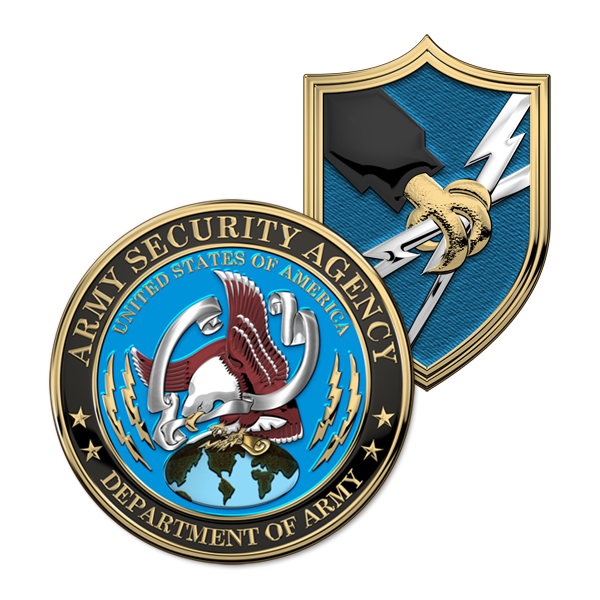
U.S. Army Security Agency (ASA)


The United States Army Security Agency (ASA) was the United States Army's signals intelligence branch. The Latin motto of the Army Security Agency was Semper Vigilis (Vigilant Always), which echoes the declaration, often misattributed to Thomas Jefferson, that "The price of freedom is eternal vigilance." The Agency existed between 1945 and 1976 and was the successor to Army signals intelligence operations dating back to World War I. ASA was under the operational control of the Director of the National Security Agency (DIRNSA), located at Fort Meade, Maryland; but had its own tactical commander at Headquarters, ASA, Arlington Hall Station, Virginia. Besides intelligence gathering, it had responsibility for the security of Army communications and for electronic countermeasures operations. In 1977, the ASA was merged with the US Army's Military Intelligence component to create the United States Army Intelligence and Security Command (INSCOM).
Composed of soldiers trained in military intelligence, the ASA was tasked with monitoring and interpreting military communications of the Soviet Union, the People's Republic of China, and their allies and client states around the world. The ASA was directly subordinate to the National Security Agency and all major field stations had NSA technical representatives present.
All gathered information had time-sensitive value depending on its importance and classification. Information was passed through intelligence channels within hours of intercept for the lowest-priority items, but in as little as 10 minutes for the most highly critical information.

ASA personnel were stationed at locations around the globe, wherever the United States had a military presence – publicly acknowledged or otherwise. In some cases, such as Eritrea, it was the primary military presence. One former Field Station, outside of Harrogate, England, in what is now North Yorkshire, was a primary listening post that was subsequently turned over to the British and became an RAF station. It is called RAF Menwith Hill and has been the site of peace protests.

As always, the artworks feturing the insignia are available via my “Military Insignia” galleries from FineArt America and RedBubble. You can just follow the links in the article to get to the corresponding galleries.

To active duty or reserve military personnel, veterans and their family members: I grant an explicit permission to download the above images to be used for non-profit/non-commercial and charitable causes, benefiting troops and their families, as well as for non-commercial internal duty-specific purposes, such as unit website design, training materials and presentations.

The above information provided in part by Wikipedia, The Institute of Heraldry, Global Security, and the official websites of the corresponding units and formations.


Tuesday, August 29, 2017

U.S. Defense Threat Reduction Agency - DTRA


The Defense Threat Reduction Agency (DTRA) is an agency within the United States Department of Defense and is the official Combat Support Agency for countering weapons of mass destruction (chemical, biological, radiological, nuclear, and high explosives). DTRA's main functions are threat reduction, threat control, combat support, and technology development. The agency is headquartered in Fort Belvoir, Virginia. DTRA (and its co-located partner organizations the SCC-WMD and SJFHQ-E) employ approximately 2,000 civilians and uniformed service members at more than a dozen permanent locations around the world. The majority of personnel are at DTRA headquarters on Fort Belvoir, Virginia. Approximately 15% of the workforce is located on Kirtland Air Force Base and the White Sands Missile Range in New Mexico, and the Nevada National Security Site (formerly called the Nevada Test Site), where they do testing and support the U.S. military's nuclear mission. Another 15% of the workforce are stationed in Germany, Kazakhstan, Azerbaijan, Uzbekistan, Georgia, Ukraine, Armenia, Kenya, South Korea, Japan, and Singapore. DTRA also has liaisons with all of the U.S. military’s Combatant Commands, the National Guard Bureau, the FBI and other U.S. government interagency partners.
 DTRA was officially established on October 1, 1998, by consolidating several DoD organizations, including the Defense Special Weapons Agency (successor to the Defense Nuclear Agency) and the On-Site Inspection Agency as a result of the 1997 Defense Reform Initiative. The Defense Technology Security Administration and the Nunn–Lugar Cooperative Threat Reduction program office in the Office of the Secretary of Defense were also incorporated into the new agency.
In 2005, the Secretary of Defense made the decision to designate the Commander, United States Strategic Command (USSTRATCOM) as the lead Combatant Command for the integration and synchronization of DoD’s Combating WMD efforts in support of U.S. government objectives. To fill this requirement, the USSTRATCOM Center for Combating Weapons of Mass Destruction (SCC-WMD) was co-located with DTRA. That responsibility was moved from USSTRATCOM over to U.S. Special Operations Command (USSOCOM), with the transition of responsibility wrapping up in early 2017.

In 2012, the Joint Elimination Coordination Element was reorganized, renamed the Standing Joint Force Headquarters for Elimination (SJFHQ-E) of Weapons of Mass Destruction, and relocated to the DTRA/SCC-WMD headquarters on Fort Belvoir. This centralized the DoD's Combating Weapons of Mass Destruction operations, a move recommended in the 2010 Quadrennial Defense Review.
On September 30, 2016, the Joint Improvised-Threat Defeat Agency (JIDA) became part of DTRA and was renamed the Joint Improvised-Threat Defeat Organization in accordance with the 2016 National Defense Authorization Act (NDAA). In Section 1532 of the NDAA, Congress directed the DoD to move JIDA to a military department or under an existing defense agency.
According to the DTRA/SCC-WMD/SJFHQ-E Strategic Plan for 2016–2020, the three organizations' shared mission is to "Safeguard the United States and its allies from global WMD threats by integrating, synchronizing, and providing expertise, technologies, and capabilities.


As always, the artworks feturing the insignia are available via my “Military Insignia” galleries from FineArt America and RedBubble. You can just follow the links in the article to get to the corresponding galleries.

To active duty or reserve military personnel, veterans and their family members: I grant an explicit permission to download the above images to be used for non-profit/non-commercial and charitable causes, benefiting troops and their families, as well as for non-commercial internal duty-specific purposes, such as unit website design, training materials and presentations.

The above information provided in part by Wikipedia, The Institute of Heraldry, Global Security, and the official websites of the corresponding units and formations.

Monday, August 28, 2017

On-Site Inspection Agency - OSIA


On January 15, 1988, President Ronald Reagan directed the Secretary of Defense to establish the On-Site Inspection Agency (OSIA), its mission was to carry out the on-site inspection and escort responsibilities of the United States under the provisions of the Intermediate-Range Nuclear Forces (lNF) Treaty. Signed on December 8, 1987, by President Reagan and Soviet General Secretary Mikhail Gorbachev, the INF Treaty enjoined the two countries to eliminate all ground launched missiles (approximately 2.700 missiles) with ranges between 500 and 5,500 kilometers. National teams of inspectors would monitor and report on the elimination of these missile systems and other significant provisions of the treaty. On-site inspections were a major component of this and all subsequent phases of the treaty. They had immediate significance, both as a barometer for measuring adherence to the treaty and as a precedent for entering into future arms control treaties and agreements. Consequently, the purpose of President Reagan's January 15, 1988, directive was to define the INF Treaty mission and to fix responsibility for the U.S. government's on-site inspection and escort mission in a new Department of Defense organization: the On-Site Inspection Agency. Eleven days after the President's directive, on January 26, 1988, William H. Taft I V, the Deputy Secretary of Defense, established OSIA as a separate operating agency in the Department of Defense.

The new agency would have three deputy directors-a Principal Deputy Director, a Deputy Director for International Negotiations, and a Deputy Director for Counterintelligence. The new organization's first charter stipulated that OSIA would have two principal responsibilities:

• To manage and coordinate the U.S. INF Treaty on-site inspection activities in the USSR, Czechoslovakia, and East Germany, and

• To manage and coordinate all United States activities associated with the Soviet Union's on-site inspections of United States' INF facilities in the United States, Belgium, Federal Republic of Germany, Italy, Netherlands, and the United Kingdom.

On February l, 1988, Brigadier General Roland Lajoie, U.S. Anny, became the first Director, On-Site Inspection Agency. The INF Treaty mission largely determined the new agency's initial organizational structure. Responsibility for planning, operational training and conducting on-site inspection and escort missions was lodged in OSIA's operations directorate. The directorate had two components: an inspection division, which prepared for and conducted U.S. on-site inspections at the 130 Soviet INF missile sites in the Soviet Union, East Germany, and Czechoslovakia: and an escort division, which was responsible for coordinating the escorting of Soviet on-site inspection teams at the 31 U.S. INF missile sites located in Western Europe and the United States. The new agency’s portal monitoring directorate had responsibility for conducting and managing the continuous on-site portal inspections.


As always, artworks featuring the insignia are available via my “Military Insignia” galleries from FineArt America and RedBubble. You can just follow the links in the article to get to the corresponding galleries.

To active duty or reserve military personnel, veterans and their family members: I grant an explicit permission to download the above images to be used for non-profit/non-commercial and charitable causes, benefiting troops and their families, as well as for non-commercial internal duty-specific purposes, such as unit website design, training materials and presentations.

The above information was exerpted from the book by Joseph P. Harahan called ON-SITE INSPECTIONS UNDER THE INF TREATY.

Saturday, August 12, 2017

Marine Force Reconnaissance (FORECON)

ForceReconnaissance (FORECON) are one of the United States Marine Corps's special operations capable forces (SOC) that provide essential elements of military intelligence to the command element of the Marine Air-Ground Task Force (MAGTF), by supporting their task force commanders, and their subordinate operating units of the Fleet Marine Force (FMF).
Historically, the Force Recon companies, detachments and platoons performed both deep reconnaissance and direct action (DA) operations. Some missions are now shared by the Marine Special Operations Teams (MSOT), due to the establishment of the U.S. Marine Special Operations Command (MARSOC) in 2006. MARSOC was formed from Force Recon's direct action platoons, and now are capable of performing many of the same mission sets for USSOCOM. This dual existence now allows the FORECON companies to focus on excelling in their primary intelligence-gathering mission, as well as the Visit, Board, Search, and Seizure (VBSS) side of the specialized raid mission.

FORECON is responsible for operating independently behind enemy lines performing unconventional special operations, in support of conventional warfare. The unit's various methods of airborne, heliborne, submarine and waterborne insertions and extractions are similar to those of the Navy SEALs, Army Special Forces, 75th Ranger Regiment, or Air Force Combat Controllers, although Force Recon's missions and tasks do differ slightly with a focus on primarily supporting Marine expeditionary and amphibious operations.

As always, the above artworks are available via my 'USMC' galleries, part of the  “Military Insignia & Heraldry” galleries from FineArt America. You can just follow the links in the article to get to the corresponding galleries.

To active duty or reserve military personnel, veterans and their family members: I grant an explicit permission to download the above images to be used for non-profit/non-commercial and charitable causes, benefiting troops and their families, as well as for non-commercial internal duty-specific purposes, such as unit website design, training materials and presentations.

The above information provided in part by Wikipedia, The Institute of Heraldry, Global Security, and the official websites of the corresponding units and formations.

Thursday, June 1, 2017

U.S. Armed Forces - Service Branches, Special Edition


'Military Insignia & Heraldry' turned seven years today. To commemorate this little anniversary, behold the 'Special Edition'.

The above artworks are available via my “Military Insignia” galleries exclusively at FineArt America. 

To active duty or reserve military personnel, veterans and their family members: I grant an explicit permission to download the above image to be used for non-profit/non-commercial and charitable causes, benefiting troops and their families, as well as for non-commercial internal duty-specific purposes, such as unit website design, training materials and presentations. 


Tuesday, May 9, 2017

Canadian Provost Corps - 'C Pro C' Badge

The Canadian Provost Corps (C Pro C) was the military police corps of the Canadian Army. The Canadian Provost Corps was authorized on 15 June 1940. The Canadian Provost Corps was amalgamated into the Canadian Forces in 1968.


In mid June 1940, the Canadian Provost Corps was officially born out of 1 Provost Company. For most of 1940, 1 Provost Company was stationed in England, but was involved in the battles during the fall of France (Brest, Laval, Sable and Chateaubriant).
The Canadian Provost Corps Training Centre operated from November 1942 to May 1946, training a total of 1,897 all ranks. During World War II, most of the Canadian Army in England was stationed at Aldershot.
Canadian MPs wore red-topped caps and were armed with .38 revolvers carried in a holster on the left hip together with white pattern 1937 web belt, brace and brace attachment in the same manner as the British Corps of Military Police (CMP).
The corps saw action for the first time on 18 August 1942 in the Dieppe Raid. Of the 41 members who took part, 22 returned to England, one was killed, eighteen were taken prisoner (seven of them being wounded). During 1943, 1 Provost Company became involved in operations in Sicily (Pachino, Valguarnera, Assoro, Agira, Adrano and Regalbuto) and after the crossing into Italy on 3 September 1943, the company continued its support of the I Canadian Corps as part of the Eighth Army as Allied forces crept northwards from the toe of Italy. Places where 1 Provost Company saw action included: Campobasso, Torella, Motta Montecorvino, San Leonardo, The Gully, and Ortona in 1943; San Nicola, San Tommaso, Cassino II, the Gustav Line, the Liri Valley, the Hitler Line, and Got Lamone Crossing in 1944; and Misano Ridge, Rimini Line, San Martino, San Lorenzo, and Fosso Vecchio in 1945. In the Cassino area of Italy, the Canadian Provost assisted the British CMP on "Highway 6", where 11,000 vehicles were handled every day. The Canadians were part of twenty-four provost and traffic control companies and two Special Investigation Branch sections that were attached to the Eighth Army.
Shortly after the Normandy landings in June 1944, the 2nd Canadian Line of Communications (LoC) Provost HQ and six sections were deployed in Northern France on traffic control duties. 1 Provost Company also saw action at Apeldoorn in the Netherlands.
On 18 October 1945, 1 Provost Company was de-activated when it was repatriated to Canada. By September 1945, the C Pro C numbered 6,120 men.
The Canadian Provost Corps School was formed at Camp Borden in the late 1940s, and by 1948 there were at least ten Provost Companies, including five Militia Provost Companies, in the Canadian Army.
25 Provost Detachment headed to Korea in 1950, where it formed part of 1 Commonwealth Division Provost Company ("1 COMWEL Div Pro Coy"). It was stated in the Standing Orders of this unit that it was the only integrated unit of its kind in the Allied Forces. In 1955, the Provost Detachment was disbanded after a total of 264 Canadian MPs had served in Korea.
From 23 November 1951, the 27th Brigade Provost Detachment was located in Hanover, West Germany with NATO. In November 1958, the 4 Canadian Infantry Brigade Group rotated into Germany and the Provost Platoon in Germany was renamed No.4 Provost Platoon.
During 1968, the platoon was renamed 4 Military Police Platoon and was located at Canadian Forces Base Lahr until the pull out of 4 Canadian Mechanised Battle Group (CMBG) in 1992.
In March 1964, the United Nations authorized a force to serve on the island of Cyprus. Members of the Military Police served on Cyprus from that time until Canada pulled out in 1992.
On 1 February 1968, the Provost Corps ceased to exist, when all branches of the Canadian military were unified into the Canadian Forces and security became the responsibility of the Canadian Armed Forces Security and Intelligence Branch.
The Canadian Military Police Heritage Hall at Canadian Forces Base Borden is a museum dedicated to the memory of the Canadian Provost Corps, Royal Canadian Air Force Service Police and Royal Canadian Navy Naval Shore Patrol Veterans in the Canadian Forces.


To active duty or reserve military personnel, veterans and their family members: I grant an explicit permission to download the above images to be used for non-profit/non-commercial and charitable causes, benefiting troops and their families, as well as for non-commercial internal duty-specific purposes, such as unit website design, training materials and presentations.

The above information provided in part by Wikipedia, The Institute of Heraldry, Global Security, and the official websites of the corresponding units and formations.
Related Posts Plugin for WordPress, Blogger...