Pages

Showing posts with label USJFCOM. Show all posts

Monday, September 19, 2011

Insignia of the United States Joint Forces Command (USJFCOM)


I have decided to continue my Unified Combatant Commands series with insignia of one of the recently disestablished UCCs. The UnitedStates Joint Forces Command (USJFCOM) was a former Unified Combatant Commands of the United States Armed Forces. USJFCOM was a functional command that provided specific services to the military. The last commander was Army Gen. Raymond T. Odierno. As directed by the President to identify opportunities to cut costs and rebalance priorities, Defense Secretary Robert Gates recommended that USJFCOM be disestablished and its essential functions reassigned to other unified combatant commands. Formal disestablishment occurred on August 4, 2011.

USJFCOM was formed in 1999 when the old United States Atlantic Command was renamed and given a new mission: leading the transformation of the U.S. military through experimentation and education. USLANTCOM had been active from 1947 to 1993 as a primarily U.S. Navy command, focused upon the wartime defense of the Atlantic sea lanes against Soviet attack. After the end of the Cold War, a 1993 reorganization gave the Command a new acronym, USACOM, and brought United States Army Forces Command and Air Combat Command under its authority.

In late 2004, U.S. Joint Forces Command assumed the role of primary conventional force provider. This landmark change assigned nearly all U.S. conventional forces to Joint Forces Command. Requirements, for example, for U.S. service personnel to support the transformation of the Armed Forces of Liberia, were fed to JFCOM, in this case via Africa Command, and JFCOM liaised with the service staffs to obtain available forces. Along with this responsibility came the task to develop a new 'risk-assessment' process that provided national leaders a world-wide perspective on force-sourcing solutions.
Its operations and exercises included Noble Resolve, an experimentation campaign plan to enhance homeland defense and improve military support to civil authorities in advance of and following natural and man-made disasters and Empire Challenge, an annual intelligence, surveillance and reconnaissance (ISR) interoperability demonstration.

United States Joint Forces Command was the only combatant command focused on the transformation of U.S. military capabilities. The commander of USJFCOM oversaw the command's four primary roles in transformation – joint concept development and experimentation, joint training, joint interoperability and integration, and the primary conventional force provider as outlined in the Unified Command Plan approved by the President. Its Unified Command Plan designated USJFCOM as the "transformation laboratory" of the United States military to enhance the combatant commanders' capabilities to implement the president's strategy. USJFCOM developed joint operational concepts, tested those concepts through rigorous experimentation, educated joint leaders, trained joint task force commanders and staffs, and recommended joint solutions to the Army, Navy, Air Force and Marines to better integrate their warfighting capabilities.

USJFCOM included members from each branch of the U.S. military, civil servants, contract employees, and consultants. It had four component commands, a sub-unified command (Special Operations component is SOCJFCOM and eight subordinate activities, including: Joint Warfighting Center; Joint Systems Integration Center; Joint Transformation Command for Intelligence; and Joint Warfare Analysis Center (JWAC). JFCOM's Service components were the CONUS based commands that provided forces to other combatant commands: United States Army Forces Command (FORSCOM), United StatesFleet Forces Command (USFLTFORCOM), Air Combat Command (ACC), and United StatesMarine Corps Forces Command (MARFORCOM).
On 9 August 2010 Secretary of Defense Robert Gates announced that Joint Forces Command has been slated for elimination as a budget-saving measure. General Ray Odierno was given the task of winding down JFCOM. On 6 January 2011, the plan was officially approved in a memorandum by President Obama. On 3 August 2011, Joint Forces Command cased its flag colors.


The United States Army Forces Command (FORSCOM) is the largest Army Command and the preeminent provider of expeditionary, campaign-capable land forces to Combatant Commanders. It is headquartered at Fort Bragg, North Carolina. FORSCOM trains, mobilizes, deploys, sustains, transforms and reconstitutes conventional forces to provide relevant and ready land power to combatant commanders worldwide in defense of the nation at home and abroad. FORSCOM is responsible for the readiness of more than 75 percent of the Army’s force structure and 87 percent of the Army’s combat power. Forces Command provides Army forces to the joint war fight. JFCOM's mission is to provide U.S. military forces where needed throughout the world and to ensure they are integrated and trained as unified forces ready for any assigned task. The capabilities of the new brigade-level formations – armor, infantry, airborne, air assault and Stryker – ensure greater flexibility and enhance FORSCOM’s ability to deploy trained and ready forces quickly.

The Active Component of FORSCOM currently has over 237,000 soldiers. Third U.S. Army, also located at Fort McPherson, is the Army component of United States Central Command, the Joint command responsible for Southwest Asia and the Horn of Africa. FORSCOM also commands three Army corps: I Corps at Fort Lewis, Washington; III Corps at Fort Hood, Texas; and XVIII Airborne Corps at Fort Bragg, North Carolina. Together they include eight divisions (1st Cavalry Division, 1st Armored Division, 1st Infantry Division, 3rd Infantry Division, 4th Infantry Division, 10th Mountain Division, 82nd Airborne Division, and the 101st Airborne Division, three separate brigades, two armored cavalry regiments, 37 support brigades of various types, and a range of other corps combat, combat support and combat service support units. First U.S. Army is responsible for training, mobilization and deployment support to Reserve Component units in FORSCOM. They also execute FORSCOM missions within their geographic areas of responsibility. A major subordinate command of Forces Command is the United States Army Reserve Command (USARC), also is headquartered at Fort Bragg, N.C. It commands all Army Reserve units in the continental United States, except those assigned to Special Operations Command. The Army National Guard provides Forces Command a balanced force of eight National Guard combat divisions, 15 brigades, and extensive combat support and combat service support units.


The United States Fleet Forces Command (USFLTFORCOM) of the United States Navy is the part of the Navy responsible for operations in and around the Atlantic Ocean. Originally formed as United States Atlantic Fleet (USLANTFLT) in 1906, it has been an integral part of the defense of the United States of America for most of the 20th century. In 2002, the Fleet comprised over 118,000 sailors and marines serving on 186 ships and in 1,300 aircraft, with an area of responsibility ranging over the Atlantic Ocean from the North Pole to the South Pole, the Caribbean Sea, Gulf of Mexico, and the waters of the Pacific Ocean along the coasts of Central and South America (as far west as the Galapagos Islands). Its operational force (i.e., the formation of fighting ships) is the United States Second Fleet. USFLTFORCOM is based at Naval Station Norfolk in Norfolk, Virginia.
The command's mission is to organize, man, train, and equip Naval Forces for assignment to Unified Command Combatant commanders; to deter, detect, and defend against homeland maritime threats; and to articulate Fleet warfighting and readiness requirements to the Chief of Naval Operations.
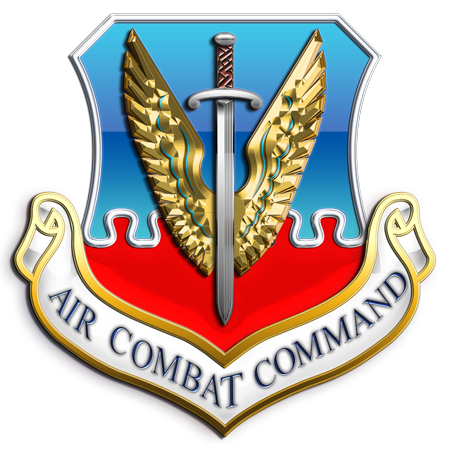


Air Combat Command (ACC) is a major command (MAJCOM) of the United States Air Force. ACC is one of ten major commands (MAJCOMs), reporting to Headquarters, United States Air Force (HAF). It is ACC is headquartered at Langley Air Force Base, Virginia. The mission of Air Combat Command is to be the primary force provider of combat airpower to America's warfighting commands. To support global implementation of national security strategy, ACC operates fighter, bomber, reconnaissance, battle-management and electronic-combat aircraft. Air Combat Command also provides command, control, computing, communications and intelligence (C4I) systems, and conducts global information operations.
As a force provider, ACC organizes, trains, equips and maintains combat-ready forces for rapid deployment and employment while ensuring strategic air defense forces are ready to meet the challenges of peacetime air sovereignty and wartime air defense.
ACC numbered air forces provide the air components to United States Central Command, United States Southern Command, former United States Joint Forces Command, United States Northern Command and United States Strategic Command.
In addition, ACC augments forces to United States European Command and United States Pacific Command.


U.S. Marine Corps Forces Command (MARFORCOM) is headquartered at Naval Support Activity Norfolk, Virginia. It was the United States Marine Corps
component of the United States Joint Forces Command (USJFCOM). It was previously known as Marine Forces Atlantic (MARFORLANT).
MARFORCOM is one of three major Marine Corps commands (along with United States Marine Corps Forces Pacific and U.S. Marine Corps Forces Reserve) that provide operating forces to support Unified or Joint Task Force Commanders and Fleet Commanders Commander, U.S. Marine Corps Forces Command (COMMARFORCOM) serves as a principal advisor to the Commander in Chief, United States Joint Forces Command (USJFCOM), on Marine Corps matters. He is responsible for organizing, training and equipping forces for employment as directed by USJFCOM.
COMMARFORCOM also serves in the following capacities:
Commanding General, Fleet Marine Force, Atlantic
Commander, United States Marine Forces, Europe
Commander, United States Marine Corps Forces, South
Commander, U.S. Marine Corps Bases, Atlantic
The warfighting arm of MARFORCOM is the II Marine Expeditionary Force (II MEF). II MEF is composed of about 45,000 personnel from the 2nd Marine Division, 2nd Marine Logistics Group and 2nd Marine Aircraft Wing.


United States Special Operations Command Joint ForcesCommand (SOCJFCOM), now Special Operations Command – Joint Capabilities(SOC-JC), was transferred to USSOCOM from the soon to be disestablished United States Joint Forces Command. It was formerly known as United States Special Operations Command Joint Forces Command (SOCJFCOM).
Primary Mission: SOC-JC trains conventional and SOF commanders and their staffs, supports USSOCOM international engagement training requirements, and supports implementation of capability solutions in order to improve strategic and operational warfighting readiness and joint interoperability. SOC-JC must also be prepared to support deployed Special Operations Joint Task Force (SOJTF) Headquarters (HQ).
As a joint sub-unified command under USSOCOM, SOC-JC’s core function is to enhance the interoperability of conventional and Special Operations Forces (SOF) commanders and staffs through robust strategic and operational level joint training. In coordination with the USSOCOM J3, J7/9 and Joint Special Operations University (JSOU), SOC-JC provides excellent training and support to the education for SOF and Conventional Forces (CF) worldwide. Additionally, SOC-JC supports the joint SOF capabilities development process while maintaining the flexibility to support emerging initiatives.


As always, the above insignia are available on a limited number of selected quality products via my “Military Insignia” galleries at Zazzle, CafePess and SpreadShirt. To get to corresponding galleries, you may simply follow the direct links in the article.

I will also make my insignia designs available free of charge to any military units and personnel, to be used for the purpose of any non-profit/non-commercial and charitable causes, benefiting troops and their families. In addition, I would make my designs available free of charge to any military branches, formations and units for any non-commercial internal duty-specific purposes, such as unit-related web design, training materials or presentations, as I have already done on numerous occasions.

The above information provided in part by The Institute of Heraldry, Global Security, Wikipedia and websites of certain Unified Combatant Commands

Monday, July 18, 2011

U.S. Department of Defense: insignia of Unified Combatant Commands

Several expansive sections of my “Military Insignia 3D” project have been dedicated exclusively to Unified Combatant Commands of the Unites States. A Unified Combatant Command (UCC) is a United States Department of Defense command that is composed of forces from at least two Military Departments and has a broad and continuing mission. These commands are established to provide effective command and control of U.S. military forces, regardless of branch of service, in peace and war. They are organized either on a geographical basis (known as "Area of Responsibility", AOR) or on a functional basis. UCCs are "joint" commands with specific badges denoting their affiliation. Each unified commands is led by a Combatant Commander (CCDR), who is a four-star General or Admiral. CCDRs exercise combatant command (COCOM), a specific type of nontransferable command authority over assigned forces, regardless of branch of service that is vested only in the CCDRs by federal law. The Chain of Command for operational purposes goes from the President to the Secretary of Defense and from the Secretary of Defense to the Combatant Commanders.

The current system of unified commands in the US military emerged during World War II with the establishment of geographic theaters of operation composed of forces from multiple service branches that reported to a single commander who was supported by a joint staff. The number of UCCs is constantly changing, and commands are constantly being merged, created, activated and deactivated.

There are 10 Current Unified Combatant Commands. Below you will find their insignia, recreated as part of my “Military Insignia 3D” project. As always, I was polishing up my Multi-Layer Enhancement & Texturing Technique (or M-LETT 3D; I discuss it in detail in this post), and kept playing with new textures and inventing a few new tricks, utilizing virtually unlimited potential of Adobe Illustrator and Photoshop CS5.
In this post I will introduce insignia of all 10 UCCs.  In real time, however, I already went much further and almost completed insignia of subordinate components for each UCC. In my future posts I will introduce each UCC along with all their components in more detail. Stay tuned.     


The United States Africa Command (USAFRICOM or AFRICOM) is one of ten Unified Combatant Commands of the United States Armed Forces, headquartered at Kelley Barracks, Stuttgart, Germany. It is responsible for U.S. military operations and military relations with 53 African nations – an area of responsibility covering all of Africa except Egypt.

The Combatant Commander of U.S. Africa Command reports to the Secretary of Defense, who in turn reports to the President of the United States. In individual countries, U.S. Ambassadors continue to be the President's personal representatives in diplomatic relations with host nations.


United States Central Command (USCENTCOM) is a theater-level Unified Combatant Command unit of the U.S. armed forces, established in 1983 under the operational control of the U.S. Secretary of Defense. It was originally conceived of as the Rapid Deployment Joint Task Force (RDJTF).
Its area of responsibility includes countries in the Middle East, North Africa, and Central Asia, most notably Afghanistan and Iraq. CENTCOM has been the main American presence in many military operations, including the Gulf War, the United States war in Afghanistan, and the Iraq War. Forces from CENTCOM currently are deployed primarily in Iraq and Afghanistan in combat roles and have bases in Kuwait, Bahrain, Qatar, the United Arab Emirates, Oman, Pakistan, and central Asia in support roles. CENTCOM forces have also been deployed in Jordan, and Saudi Arabia in the past, although no substantial forces are based in those countries as of 2009.

Of the six American regional unified commands, CENTCOM is one of three regional unified commands whose headquarters are not within its area of operations. CENTCOM's main headquarters is located at MacDill Air Force Base, in Tampa, Florida, although a forward headquarters was established in 2002 at Camp As Sayliyah in Doha, Qatar, which transitioned to a new forward headquarters at Al Udeid Air Base in Qatar in 2009 to serve American strategic interests of the Iraq region.


The United States European Command (EUCOM) is one of ten Unified Combatant Commands of the United States military, headquartered in Stuttgart, Germany. Its area of focus covers 21,000,000 square miles (54,000,000 km2) and 51 countries and territories, including Europe, Russia, Iceland, Greenland, and Israel. The Commander of EUCOM simultaneously serves as the Supreme Allied Commander, Europe (SACEUR) within NATO.
EUCOM was established on 1 August 1952, to provide "unified command and authority" over all United States forces in Europe. During the Cold War and the Kosovo War, EUCOM was the lead command for potential operations. During the Gulf War and Operation Northern Watch, EUCOM controlled the forces flying from Incirlik Air Base.

Immediately after the terrorist attacks against New York and Washington, D.C., on 11 September 2001, NATO invoked Article V of the treaty and deployed NATO early warning aircraft to help monitor the skies over North America. EUCOM provided major forces for subsequent operations in Afghanistan and stepped up its efforts to protect United States interests in Europe and Africa. Subsequent terrorist attacks in the EUCOM theater in Casablanca, Madrid, London and Algiers prompted EUCOM to launch Operation Enduring Freedom Trans-Sahara in 2007 while continuing to provide rotational forces to Afghanistan and Iraq.

In 2003, the headquarters reorganized to establish the EUCOM Plans and Operations Center (EPOC). From 2006 to 2008, EUCOM helped stand-up a new geographic unified combatant command, United States Africa Command (AFRICOM), which took over responsibility for Department of Defense activities in Africa on 1 October 2008.


United States Joint Forces Command (USJFCOM) is one of ten Unified Combatant Commands of the United States Armed Forces. Unlike the six commands with responsibility for war plans and operations in specified portions of the world, USJFCOM is a functional command that provides specific services to the military, and the only combatant command focused on the transformation of U.S. military capabilities.  As directed by the President to identify opportunities to cut costs and rebalance priorities, Defense Secretary Robert Gates recommended in August 2010 that USJFCOM be disestablished and its essential functions assigned to other organizations. President Barack Obama approved the command's disestablishment 6 January 2011. The target date for disestablishment is set for no later than 31 August 2011.

USJFCOM was formed in 1999 when the old United States Atlantic Command was renamed and given a new mission: leading the transformation of the U.S. military through experimentation and education. USLANTCOM had been active from 1947 to 1993 as a primarily U.S. Navy command, focused upon the wartime defense of the Atlantic sea lanes against Soviet attack. After the end of the Cold War, a 1993 reorganization gave the Command a new acronym, USACOM, and brought United States Army Forces Command and Air Combat Command under its authority. In late 2004, U.S. Joint Forces Command assumed the role of primary conventional force provider. This landmark change assigned nearly all U.S. conventional forces to Joint Forces Command.


United States Northern Command (USNORTHCOM, or informally just NORTHCOM) is a Unified Combatant Command of the United States military. Created on 1 October 2002 in the aftermath of the 11 September 2001 attacks, its mission is to protect the United States homeland and support local, state, and federal authorities. The support that USNORTHCOM provides to civil authorities is limited by the Posse Comitatus Act which limits the role of the U.S. military in civil law enforcement. However, in case of national emergencies, natural or man-made, its Air Forces Northern National Security Emergency Preparedness Directorate will take charge of the situation or event.
USNORTHCOM’s Area of Responsibility (AOR) includes air, land and sea approaches and encompasses the contiguous United States, Alaska, Canada, Mexico and the surrounding water out to approximately 500 nautical miles (930 km). It also includes the Gulf of Mexico, the Straits of Florida, portions of the Caribbean region to include The Bahamas, Puerto Rico, and the U.S. Virgin Islands. 

The commander of USNORTHCOM is responsible for theater security cooperation with Canada, Mexico, and The Bahamas.  USNORTHCOM is composed of several standing Joint Task Forces (JTFs) previously assigned to United States Joint Forces Command (USJFCOM): Joint Force Headquarters National Capital Region, Joint Task Force-Civil Support, Joint Task Force Alaska, and Joint Task Force North. USNORTHCOM service components include U.S. Fifth Army/ARNORTH, First Air Force/AFNORTH, and United States Fleet Forces Command.


The United States Pacific Command (USPACOM) is a Unified Combatant Command of the armed forces of the United States, led by the Commander, Pacific Command (CDRUSPACOM), is the supreme military authority for the various branches of the Armed Forces of the United States serving within its area of responsibility (AOR). Only the President of the United States, who is Commander-in-Chief of the Armed Forces, and the Secretary of Defense advised by the Joint Chiefs of Staff (JCS) have greater authority. It is the oldest and largest of the ten Unified Combatant Commands. It is based in Honolulu, Hawai'i on the island of O'ahu.

The United States Pacific Command was established on 1 January 1947 by President Harry Truman and was originally headquartered in the Salt Lake subdivision of Honolulu. The main combat power of USPACOM is formed by U.S. Army Pacific, Marine Forces Pacific, U.S. Pacific Fleet, and Pacific Air Forces, all headquartered in Honolulu with component forces stationed throughout the region. The United States Pacific Command's area of jurisdiction covers over fifty percent of the world's surface area – approximately 105 million square miles (nearly 272 million square kilometers) – nearly sixty percent of the world's population, thirty-six countries, twenty territories, and ten territories and possessions of the United States.


The United States Southern Command (USSOUTHCOM), located in Miami, Florida, is one of ten Unified Combatant Commands (COCOMs) in the United States Department of Defense. It is responsible for providing contingency planning and operations in Central and South America, the Caribbean (except U.S. commonwealths, territories, and possessions), Cuba, their territorial waters, and for the force of U.S. military resources at these locations. USSOUTHCOM is also responsible for ensuring the militarization of the Panama Canal and canal area.

Under the leadership of a four-star Commander, USSOUTHCOM is organized into a headquarters with six main directorates, component commands and military groups that represent SOUTHCOM in the region of Central America, South America and the Caribbean.

USSOUTHCOM is a joint command of more than 1,200 military and civilian personnel representing the United States Army, Navy, Air Force, Marine Corps, Coast Guard, and several other federal agencies. Civilians working at USSOUTHCOM are, for the most part, civilian employees of the Army, as the Army is USSOUTHCOM's Combatant Command Support Agent. The Services provide USSOUTHCOM with component commands which, along with their Joint Special Operations component, two Joint Task Forces, one Joint Interagency Task Force, and Security Cooperation Offices, perform USSOUTHCOM missions and activities. USSOUTHCOM exercises its COCOM authority through the commanders of its components, Joint Task Forces/Joint Interagency Task Force, and Security Cooperation Organizations


United States Special Operations Command (USSOCOM) is the Unified Combatant Command charged with overseeing the various Special Operations Commands (SOC or SOCOM) of the Army, Air Force, Navy and Marine Corps of the United States armed forces. The command is part of the Department of Defense. USSOCOM is headquartered at MacDill Air Force Base in Tampa, Florida.

USSOCOM conducts several covert and clandestine missions, such as unconventional warfare, foreign internal defense, special reconnaissance, psychological operations, Civil Affairs, direct action, counter-terrorism and War on Drugs operations. Each branch has a Special Operations Command that is unique and capable of running its own operations, but when the different Special Operations Forces need to work together for an operation, USSOCOM becomes the joint component command of the operation, instead of a SOC of a specific branch.


United States Strategic Command (USSTRATCOM) is one of the ten Unified Combatant Commands of the United States Department of Defense (DoD). The Command, including components, employs more than 2,700 people, representing all four services, including DoD civilians and contractors, who oversee the command's operationally focused global strategic mission.
Strategic Command was established in 1992 as a successor to Strategic Air Command (SAC).

It is charged with space operations (such as military satellites), information operations (such as information warfare), missile defense, global command and control, intelligence, surveillance, and reconnaissance (C4ISR), global strike and strategic deterrence (the United States nuclear arsenal), and combating weapons of mass destruction.

USSTRATCOM is headquartered at Offutt Air Force Base south of Omaha, Nebraska. In October 2002, USSTRATCOM merged with the United States Space Command (USSPACECOM).
USSTRATCOM is one of the four Unified Combatant Commands organized along a functional basis. The other six are organized on a geographical basis.


The United States Transportation Command (USTRANSCOM) is one of ten unified commands of the United States Department of Defense. The mission of USTRANSCOM is to provide air, land and sea transportation for the Department of Defense, both in time of peace and time of war.

USTRANSCOM, located at Scott Air Force Base Illinois, was established in 1987. As the single manager of America's global defense transportation system, USTRANSCOM is tasked with the coordination of people and transportation assets to allow the US to project and sustain forces, whenever, wherever, and for as long as they are needed.

Composed of three component commands: The Air Force's Air Mobility Command, the Navy's Military Sealift Command and the Army's Surface Deployment and Distribution Command, USTRANSCOM coordinates missions worldwide using both military and commercial transportation resources. Agencies within the command headquarters include JOSAC (Joint Operational Support Airlift Center).


As always, the above insignia are available on a limited number of selected high quality products via my “Military Insignia” galleries exclusively from Zazzle.com. You can just follow the links in the article to get to the corresponding galleries.

I will also make my insignia designs available free of charge to any military units and personnel to be used for non-profit/non-commercial and charitable causes, benefiting troops and their families, as well as for non-commercial internal units’ duty-specific purposes, such as unit website design, training materials and presentations, as I have already done on a number of occasions.


The above information provided in part by The Institute of Heraldry, Global Security, Wikipedia and websites of certain Unified Combatant Commands

Related Posts Plugin for WordPress, Blogger...