Pages

Showing posts with label Military insignia. Show all posts

Monday, July 18, 2011

U.S. Department of Defense: insignia of Unified Combatant Commands

Several expansive sections of my Military Insignia 3D project have been dedicated exclusively to Unified Combatant Commands of the Unites States. A Unified Combatant Command (UCC) is a United States Department of Defense command that is composed of forces from at least two Military Departments and has a broad and continuing mission. These commands are established to provide effective command and control of U.S. military forces, regardless of branch of service, in peace and war. They are organized either on a geographical basis (known as "Area of Responsibility", AOR) or on a functional basis. UCCs are "joint" commands with specific badges denoting their affiliation. Each unified commands is led by a Combatant Commander (CCDR), who is a four-star General or Admiral. CCDRs exercise combatant command (COCOM), a specific type of nontransferable command authority over assigned forces, regardless of branch of service that is vested only in the CCDRs by federal law. The Chain of Command for operational purposes goes from the President to the Secretary of Defense and from the Secretary of Defense to the Combatant Commanders.

The current system of unified commands in the US military emerged during World War II with the establishment of geographic theaters of operation composed of forces from multiple service branches that reported to a single commander who was supported by a joint staff. The number of UCCs is constantly changing, and commands are constantly being merged, created, activated and deactivated.

There are 10 Current Unified Combatant Commands. Below you will find their insignia, recreated as part of my “Military Insignia 3D” project. As always, I was polishing up my Multi-Layer Enhancement & Texturing Technique (or M-LETT 3D; I discuss it in detail in this post), and kept playing with new textures and inventing a few new tricks, utilizing virtually unlimited potential of Adobe Illustrator and Photoshop CS5.
In this post I will introduce insignia of all 10 UCCs.  In real time, however, I already went much further and almost completed insignia of subordinate components for each UCC. In my future posts I will introduce each UCC along with all their components in more detail. Stay tuned.     


The United States Africa Command (USAFRICOM or AFRICOM) is one of ten Unified Combatant Commands of the United States Armed Forces, headquartered at Kelley Barracks, Stuttgart, Germany. It is responsible for U.S. military operations and military relations with 53 African nations – an area of responsibility covering all of Africa except Egypt.

The Combatant Commander of U.S. Africa Command reports to the Secretary of Defense, who in turn reports to the President of the United States. In individual countries, U.S. Ambassadors continue to be the President's personal representatives in diplomatic relations with host nations.


United States Central Command (USCENTCOM) is a theater-level Unified Combatant Command unit of the U.S. armed forces, established in 1983 under the operational control of the U.S. Secretary of Defense. It was originally conceived of as the Rapid Deployment Joint Task Force (RDJTF).
Its area of responsibility includes countries in the Middle East, North Africa, and Central Asia, most notably Afghanistan and Iraq. CENTCOM has been the main American presence in many military operations, including the Gulf War, the United States war in Afghanistan, and the Iraq War. Forces from CENTCOM currently are deployed primarily in Iraq and Afghanistan in combat roles and have bases in Kuwait, Bahrain, Qatar, the United Arab Emirates, Oman, Pakistan, and central Asia in support roles. CENTCOM forces have also been deployed in Jordan, and Saudi Arabia in the past, although no substantial forces are based in those countries as of 2009.

Of the six American regional unified commands, CENTCOM is one of three regional unified commands whose headquarters are not within its area of operations. CENTCOM's main headquarters is located at MacDill Air Force Base, in Tampa, Florida, although a forward headquarters was established in 2002 at Camp As Sayliyah in Doha, Qatar, which transitioned to a new forward headquarters at Al Udeid Air Base in Qatar in 2009 to serve American strategic interests of the Iraq region.


The United States European Command (EUCOM) is one of ten Unified Combatant Commands of the United States military, headquartered in Stuttgart, Germany. Its area of focus covers 21,000,000 square miles (54,000,000 km2) and 51 countries and territories, including Europe, Russia, Iceland, Greenland, and Israel. The Commander of EUCOM simultaneously serves as the Supreme Allied Commander, Europe (SACEUR) within NATO.
EUCOM was established on 1 August 1952, to provide "unified command and authority" over all United States forces in Europe. During the Cold War and the Kosovo War, EUCOM was the lead command for potential operations. During the Gulf War and Operation Northern Watch, EUCOM controlled the forces flying from Incirlik Air Base.

Immediately after the terrorist attacks against New York and Washington, D.C., on 11 September 2001, NATO invoked Article V of the treaty and deployed NATO early warning aircraft to help monitor the skies over North America. EUCOM provided major forces for subsequent operations in Afghanistan and stepped up its efforts to protect United States interests in Europe and Africa. Subsequent terrorist attacks in the EUCOM theater in Casablanca, Madrid, London and Algiers prompted EUCOM to launch Operation Enduring Freedom Trans-Sahara in 2007 while continuing to provide rotational forces to Afghanistan and Iraq.

In 2003, the headquarters reorganized to establish the EUCOM Plans and Operations Center (EPOC). From 2006 to 2008, EUCOM helped stand-up a new geographic unified combatant command, United States Africa Command (AFRICOM), which took over responsibility for Department of Defense activities in Africa on 1 October 2008.


United States Joint Forces Command (USJFCOM) is one of ten Unified Combatant Commands of the United States Armed Forces. Unlike the six commands with responsibility for war plans and operations in specified portions of the world, USJFCOM is a functional command that provides specific services to the military, and the only combatant command focused on the transformation of U.S. military capabilities.  As directed by the President to identify opportunities to cut costs and rebalance priorities, Defense Secretary Robert Gates recommended in August 2010 that USJFCOM be disestablished and its essential functions assigned to other organizations. President Barack Obama approved the command's disestablishment 6 January 2011. The target date for disestablishment is set for no later than 31 August 2011.

USJFCOM was formed in 1999 when the old United States Atlantic Command was renamed and given a new mission: leading the transformation of the U.S. military through experimentation and education. USLANTCOM had been active from 1947 to 1993 as a primarily U.S. Navy command, focused upon the wartime defense of the Atlantic sea lanes against Soviet attack. After the end of the Cold War, a 1993 reorganization gave the Command a new acronym, USACOM, and brought United States Army Forces Command and Air Combat Command under its authority. In late 2004, U.S. Joint Forces Command assumed the role of primary conventional force provider. This landmark change assigned nearly all U.S. conventional forces to Joint Forces Command.


United States Northern Command (USNORTHCOM, or informally just NORTHCOM) is a Unified Combatant Command of the United States military. Created on 1 October 2002 in the aftermath of the 11 September 2001 attacks, its mission is to protect the United States homeland and support local, state, and federal authorities. The support that USNORTHCOM provides to civil authorities is limited by the Posse Comitatus Act which limits the role of the U.S. military in civil law enforcement. However, in case of national emergencies, natural or man-made, its Air Forces Northern National Security Emergency Preparedness Directorate will take charge of the situation or event.
USNORTHCOM’s Area of Responsibility (AOR) includes air, land and sea approaches and encompasses the contiguous United States, Alaska, Canada, Mexico and the surrounding water out to approximately 500 nautical miles (930 km). It also includes the Gulf of Mexico, the Straits of Florida, portions of the Caribbean region to include The Bahamas, Puerto Rico, and the U.S. Virgin Islands. 

The commander of USNORTHCOM is responsible for theater security cooperation with Canada, Mexico, and The Bahamas.  USNORTHCOM is composed of several standing Joint Task Forces (JTFs) previously assigned to United States Joint Forces Command (USJFCOM): Joint Force Headquarters National Capital Region, Joint Task Force-Civil Support, Joint Task Force Alaska, and Joint Task Force North. USNORTHCOM service components include U.S. Fifth Army/ARNORTH, First Air Force/AFNORTH, and United States Fleet Forces Command.


The United States Pacific Command (USPACOM) is a Unified Combatant Command of the armed forces of the United States, led by the Commander, Pacific Command (CDRUSPACOM), is the supreme military authority for the various branches of the Armed Forces of the United States serving within its area of responsibility (AOR). Only the President of the United States, who is Commander-in-Chief of the Armed Forces, and the Secretary of Defense advised by the Joint Chiefs of Staff (JCS) have greater authority. It is the oldest and largest of the ten Unified Combatant Commands. It is based in Honolulu, Hawai'i on the island of O'ahu.

The United States Pacific Command was established on 1 January 1947 by President Harry Truman and was originally headquartered in the Salt Lake subdivision of Honolulu. The main combat power of USPACOM is formed by U.S. Army Pacific, Marine Forces Pacific, U.S. Pacific Fleet, and Pacific Air Forces, all headquartered in Honolulu with component forces stationed throughout the region. The United States Pacific Command's area of jurisdiction covers over fifty percent of the world's surface area – approximately 105 million square miles (nearly 272 million square kilometers) – nearly sixty percent of the world's population, thirty-six countries, twenty territories, and ten territories and possessions of the United States.


The United States Southern Command (USSOUTHCOM), located in Miami, Florida, is one of ten Unified Combatant Commands (COCOMs) in the United States Department of Defense. It is responsible for providing contingency planning and operations in Central and South America, the Caribbean (except U.S. commonwealths, territories, and possessions), Cuba, their territorial waters, and for the force of U.S. military resources at these locations. USSOUTHCOM is also responsible for ensuring the militarization of the Panama Canal and canal area.

Under the leadership of a four-star Commander, USSOUTHCOM is organized into a headquarters with six main directorates, component commands and military groups that represent SOUTHCOM in the region of Central America, South America and the Caribbean.

USSOUTHCOM is a joint command of more than 1,200 military and civilian personnel representing the United States Army, Navy, Air Force, Marine Corps, Coast Guard, and several other federal agencies. Civilians working at USSOUTHCOM are, for the most part, civilian employees of the Army, as the Army is USSOUTHCOM's Combatant Command Support Agent. The Services provide USSOUTHCOM with component commands which, along with their Joint Special Operations component, two Joint Task Forces, one Joint Interagency Task Force, and Security Cooperation Offices, perform USSOUTHCOM missions and activities. USSOUTHCOM exercises its COCOM authority through the commanders of its components, Joint Task Forces/Joint Interagency Task Force, and Security Cooperation Organizations


United States Special Operations Command (USSOCOM) is the Unified Combatant Command charged with overseeing the various Special Operations Commands (SOC or SOCOM) of the Army, Air Force, Navy and Marine Corps of the United States armed forces. The command is part of the Department of Defense. USSOCOM is headquartered at MacDill Air Force Base in Tampa, Florida.

USSOCOM conducts several covert and clandestine missions, such as unconventional warfare, foreign internal defense, special reconnaissance, psychological operations, Civil Affairs, direct action, counter-terrorism and War on Drugs operations. Each branch has a Special Operations Command that is unique and capable of running its own operations, but when the different Special Operations Forces need to work together for an operation, USSOCOM becomes the joint component command of the operation, instead of a SOC of a specific branch.


United States Strategic Command (USSTRATCOM) is one of the ten Unified Combatant Commands of the United States Department of Defense (DoD). The Command, including components, employs more than 2,700 people, representing all four services, including DoD civilians and contractors, who oversee the command's operationally focused global strategic mission.
Strategic Command was established in 1992 as a successor to Strategic Air Command (SAC).

It is charged with space operations (such as military satellites), information operations (such as information warfare), missile defense, global command and control, intelligence, surveillance, and reconnaissance (C4ISR), global strike and strategic deterrence (the United States nuclear arsenal), and combating weapons of mass destruction.

USSTRATCOM is headquartered at Offutt Air Force Base south of Omaha, Nebraska. In October 2002, USSTRATCOM merged with the United States Space Command (USSPACECOM).
USSTRATCOM is one of the four Unified Combatant Commands organized along a functional basis. The other six are organized on a geographical basis.


The United States Transportation Command (USTRANSCOM) is one of ten unified commands of the United States Department of Defense. The mission of USTRANSCOM is to provide air, land and sea transportation for the Department of Defense, both in time of peace and time of war.

USTRANSCOM, located at Scott Air Force Base Illinois, was established in 1987. As the single manager of America's global defense transportation system, USTRANSCOM is tasked with the coordination of people and transportation assets to allow the US to project and sustain forces, whenever, wherever, and for as long as they are needed.

Composed of three component commands: The Air Force's Air Mobility Command, the Navy's Military Sealift Command and the Army's Surface Deployment and Distribution Command, USTRANSCOM coordinates missions worldwide using both military and commercial transportation resources. Agencies within the command headquarters include JOSAC (Joint Operational Support Airlift Center).


As always, the above insignia are available on a limited number of selected high quality products via my “Military Insignia” galleries exclusively from Zazzle.com. You can just follow the links in the article to get to the corresponding galleries.

I will also make my insignia designs available free of charge to any military units and personnel to be used for non-profit/non-commercial and charitable causes, benefiting troops and their families, as well as for non-commercial internal units’ duty-specific purposes, such as unit website design, training materials and presentations, as I have already done on a number of occasions.


The above information provided in part by The Institute of Heraldry, Global Security, Wikipedia and websites of certain Unified Combatant Commands

Sunday, July 3, 2011

Military Insignia 3D is expanding: meet Britain, Australia, Germany and France


When I just started working on my “Military Insignia 3D” project, I have decided that the emphasis will be put on insignia of Canadian Armed Forces and Armed forces of the USA. However, at some point, I was planning to expand the project to encompass military heraldry of other countries as well. So, at this point I have decided that the time has come. You all know the sad story behind the Canadian chapter of the project. In case if you missed it, you can find it here. Hopefully, my other international galleries will be in for a better and brighter future. Only the time will tell. Nevertheless, I continue having fun, and the project keeps getting bigger and better. 

At this stage of the project, I have decided to recreate major emblems of the British, Australian, German and French armed forces. Business as usual. I keep improving my M-LETT (Multi-Layer Enhancement & Texturing  Technique), and keep delving into the limitless possibilities of Adobe Photoshop and Adobe Illustrator CS5. The end results speak for themselves. Be the first to take a glimpse at my international entries of the “Military Insignia 3D” …  


The armed forces of the United Kingdom, known as Her Majesty's Armed Forces or sometimes the British Armed Forces, and sometimes legally the Armed Forces of the Crown, encompasses the Royal Navy, the British Army, and the Royal Air Force. The British Armed Forces are a purely professional and volunteer force, and constitute the second largest military in the EU in terms of professional personnel and reserves.

The British Armed Forces are charged with protecting the United Kingdom and its overseas territories, promoting Britain's wider security interests, and supporting international peacekeeping efforts. They are active and regular participants in NATO and other coalition operations. Britain is also party to the Five Power Defence Arrangements. 

Recent operations have included wars in Afghanistan and Iraq, the 2000 intervention in Sierra Leone, ongoing peacekeeping responsibilities in the Balkans and Cyprus, and participation in the UN-mandated no-fly zone over Libya. Overseas garrisons and facilities are maintained at Ascension Island, Belize, Brunei, Canada, Diego Garcia, the Falkland Islands, Germany, Gibraltar, Kenya, Qatar and the Sovereign Base Areas (Cyprus).


The Australian Defence Force (ADF) is the military organization responsible for the defence of Australia. It consists of the Royal Australian Navy, the Australian Army, the Royal Australian Air Force and a number of 'tri-service' units.

During the first decades of the 20th century, the Australian Government established three separate armed services. Each service had an independent chain of command. In 1976, the government made a strategic change and established the ADF to place the services under a single headquarters. 

Over time, the degree of integration has increased and tri-service headquarters, logistics and training institutions have supplanted many single-service establishments.

The ADF is technologically sophisticated but relatively small. Although the ADF's 57,697 full-time active-duty personnel, 21,248 active reserves and 22,166 standby reserves make it the largest military in Oceania, it is still smaller than most Asian militaries. Nonetheless, the ADF is able to deploy forces in multiple locations outside Australia.

ADF has three priorities. The first of these priorities is to maintain the capability to defend Australian territory from any credible attack, without relying on help from the combat forces of any other country. The second priority is to contribute to the security of Australia's immediate neighbourhood through working with neighbouring countries and participating in United Nations-sanctioned peacekeeping operations. The third priority for the ADF is to contribute to international coalitions of forces outside of Australia's immediate neighbourhood where Australian interests are engaged. The ADF is also responsible for contributing to coastal surveillance and responding to emergencies, including natural disasters.


The Bundeswehr consists of the unified armed forces of Germany and their civil administration and procurement authorities. The States of Germany are not allowed to maintain armed forces of their own, since the German Constitution states that matters of defense fall into the sole responsibility of the federal government.

The Bundeswehr is divided into a military part (armed forces or Streitkräfte) and a civil part with the armed forces administration (Wehrverwaltung), the federal bureau of procurement (Bundesamt für Wehrtechnik und Beschaffung) and the federal bureau for information management and information technology of the Bundeswehr (Bundesamt für Informationsmanagement und Informationstechnik der Bundeswehr, sometimes abbreviated as IT-AmtBw). 

The military part of the federal defense force consists of Army (Heer), Navy (Marine), Air Force (Luftwaffe), Joint Support Service (Streitkräftebasis), and Central Medical Services (Zentraler Sanitätsdienst) branches.


The French Armed Forces encompass the French Army (Armée de Terre), the French Navy (Marine Nationale), the French Air Force (Armée de l'Air) and the National Gendarmerie (Gendarmerie nationale). The President of the Republic heads the armed forces, with the title "chef des armées" ("chief of the military forces"). The President is the supreme authority for military matters and is the sole official who can order a nuclear strike. The French military has, as some of its primary objectives, the defence of national territory, the protection of French interests abroad, and the maintenance of global stability. The French Armed Forces is the largest military in the European Union in terms of man-power and the third largest in NATO. In 2009, the French Armed Forces had the third highest expenditure of any military in the world, as well as the third largest nuclear arsenal in the world, behind only the United States and Russia.


As I mentioned earlier, the above insignia is available on a limited number of selected high quality products via my “Military Insignia” galleries exclusively from Zazzle.com. You can just follow the links in the article to navigate to the corresponding galleries. 

I will also make my insignia designs available free of charge to any non-profit/non-commercial and charitable causes, benefiting troops and their families, as I have already done on a number of occasions.


Information provided in part by websites of the British, Australian, German and French armed forces and Wikipedia


Tuesday, May 3, 2011

Who killed Osama bin Laden: meet the major players


Events of the last few days prompted me to interrupt the flow of my "Military Insignia" project. As soon as the news hit the air - Osama bin Laden, the notorious Al-Qaeda leader, has been killed – I figured that this would be good time to expand my “Special Forces” collection, focusing on the insignias of those commands, units and agencies, which allegedly participated in the operation.
Of course, we will never know for sure how it all went down and who exactly carried it out and contributed to the operation – such details will remain heavily classified. However, here is the official version of the event.

On May 1/2 2011, the United States Naval Special Warfare Development Group (NSWDG), also known as DEVGRU or  SEAL Team Six (ST6) , was involved in the operation codenamed "Geronimo", during which Osama bin Laden, leader of Al Qaeda and America's most wanted terrorist, was shot and killed at his compound in the affluent suburb of Abottabad, Pakistan. Modified MH-60 helicopters from the U.S. Army's 160th Special Operations Aviation Regiment, carried Navy SEALs and were supported by other personnel with tactical signals, intelligence collectors, and navigators using highly classified hyperspectral imagers from Ghazi Air Base in Pakistan.The operation was carried out with support of other Joint Special Operations Command (JSOC) units, the Technical Application Programs Office and the Aviation Technology Evaluation Group. The raid also involved close collaboration with the CIA, the National Security Agency (NSA), and the National Geospatial-Intelligence Agency.
DEVGRU, or SEAL Team Six, are the U.S. Navy's principal special operations force and is a part of the Naval Special Warfare Command (NSWC) as well as the maritime component of the United States Special Operations Command (USSOCOM) and United States Joint Special Operations Command (JSOC).
This was quite a few insignia to cover. Thankfully, some of them were created earlier, as part of my “Special Forces” stretch of the project, which I covered in detail in one of my earlier posts here. So, without further ado, meet the major players of the operation “Geronimo”, at least according to the official version of the event.


USSOCOM is the Unified Combatant Command charged with overseeing the various Special Operations Commands (SOC or SOCOM) of the Army, Air Force, Navy and Marine Corps of the United States armed forces. The command is part of the Department of Defense. USSOCOM is headquartered at MacDill Air Force Base in Tampa, Florida.
USSOCOM conducts several covert and clandestine missions, such as unconventional warfare, foreign internal defense, special reconnaissance, psychological operations, Civil Affairs, direct action, counter-terrorism and War on Drugs operations. Each branch has a Special Operations Command that is unique and capable of running its own operations, but when the different Special Operations Forces need to work together for an operation, USSOCOM becomes the joint component command of the operation, instead of a SOC of a specific branch.


The Central Intelligence Agency (CIA) is a civilian intelligence agency of the United States government, reporting to the Director of National Intelligence, responsible for providing national security intelligence assessment to senior United States policymakers. The CIA also engages in covert activities at the request of the President of the United States.


It is the successor of the Office of Strategic Services (OSS) formed during World War II to coordinate espionage activities against the Axis Powers for the branches of the United States Armed Forces. 


The primary function of the CIA is to collect information about foreign governments, corporations, and individuals, and to advise public policymakers. The agency conducts covert operations and paramilitary actions, and exerts foreign political influence through its Special Activities Division. 
Sometimes, in government and military circles the CIA is indirectly referred to as Other Government Agencies (OGA), particularly when its operations in a particular area are an open secret. Other terms include The Company, Langley and The Agency.


The National Security Agency/Central Security Service (NSA/CSS) is a cryptologic intelligence agency of the United States Department of Defense responsible for the collection and analysis of foreign communications and foreign signals intelligence, as well as protecting U.S. government communications and information systems, which involves cryptanalysis and cryptography.
The NSA is directed by at least a lieutenant general or vice admiral. NSA is a key component of the U.S. Intelligence Community, which is headed by the Director of National Intelligence. The Central Security Service is a co-located agency created to coordinate intelligence activities and co-operation between NSA and other U.S. military cryptanalysis agencies. The Director of the NSA is also the Commander of the Joint Functional Component Command – Network Warfare. NSA's work is limited to communications intelligence; it does not perform field or human intelligence activities.


The Central Security Service (CSS) is an agency of the United States Department of Defense, established in 1972 by a Presidential Directive to promote full partnership between the National Security Agency (NSA) and the Service Cryptologic Elements (SCE) of the United States Armed Forces. 


The blue background of the CSS emblem represents "fidelity" and "steadfastness", with the symbols for the cryptologic service elements provided shown clockwise from top right as follows: Army Intelligence and Security Command, United States Marine Corps, Naval Security Group, United States Coast Guard and Air Force Intelligence, Surveillance and Reconnaissance Agency with the symbol of the National Security Agency in the center.


NSA/CSS was initially conceived as a separate "fourth service" beside the three U.S. armed services. The latter three resisted this idea, and therefore the CSS was founded as an inter-service organization. The day-to-day work of the CSS is to capture enemy signals (radar, telemetry, radio/satellite communications) using the means of the involved service. For example, the Navy has special submarines for tapping undersea cables; the Air Force operates aircraft with sophisticated antennas and processing gear to listen to enemy radar and radio; and on the ground, the Army operates similar eavesdropping equipment.


Joint Special Operations Command (JSOC) is
a component command of the United States Special Operations Command (USSOCOM) and is charged to study special operations requirements and techniques to ensure interoperability and equipment standardization, plan and conduct special operations exercises and training, and develop Joint Special Operations Tactics. It was established in 1980 on recommendation of Col. Charlie Beckwith, in the aftermath of the failure of Operation Eagle Claw. It is located at Pope Army Air Field and Fort Bragg in North Carolina, USA. The Joint Special Operations Command (JSOC) also commands and controls the Special Mission Units (SMU) of United States Special Operations Command (USSOCOM). These units perform highly classified activities. So far, only three SMUs have been publicly disclosed: The Army's 1st Special Forces Operational Detachment - Delta, the Navy's Naval Special Warfare Development Group, and the Air Force's 24th Special Tactics Squadron. The Intelligence Support Activity is also under JSOC.


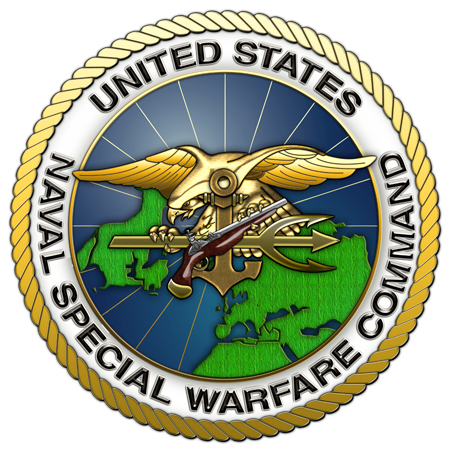
The United States Naval Special Warfare Command (NAVSPECWARCOM, NAVSOC or NSWC) was commissioned on 16 April 1987, at Naval Amphibious Base Coronado in San Diego, California. As the Naval component to the United States Special Operations Command, headquartered at MacDill AFB in Tampa, Florida, Naval Special Warfare Command provides vision, leadership, doctrinal guidance, resources and oversight to ensure component maritime special operations forces are ready to meet the operational requirements of combatant commanders.
NSW is committed to combating the global terrorist threats. In addition to being experts in special reconnaissance and direct action missions, the skill sets needed to combat terrorism; NSW is postured to fight a dispersed enemy on their turf. NSW forces can operate from forward-deployed Navy ships, submarines and aviation mobility platforms as well as overseas bases and its own overseas units.


The United States Navy SEa, Air and Land (SEAL) Teams, commonly known as Navy SEALs, are the U.S. Navy's principal special operations force and are part of the Naval Special Warfare Command (NSWC) as well as the maritime component of the United States Special Operations Command (USSOCOM).
The unit's acronym ("SEAL") is derived from their capacity to operate at sea, in the air, and on land – but it is their ability to work underwater that separates SEALs from most other military units in the world. The experience gained from operating in the ocean and freshwater battlefields has shaped their identity and, as a result, they are regarded as being amongst the most highly skilled and trained amphibious units in the world. Navy SEALs are trained and have been deployed in a wide variety of missions, including direct action and special reconnaissance operations, unconventional warfare, foreign internal defense, hostage rescue, counter-terrorism, and other missions. Without exception, all SEALs are male members of either the United States Navy or the United States Marine Corps.


The United States Navy SEALs Team Six, also known as United States Naval Special Warfare Development Group (NSWDG) or DEVGRU, is one of the United States' two secretive Tier One counter-terrorism and Special Mission Units (SMUs); the other such group is 1st SFOD-D (Delta Force).
Most recently DEVGRU's designation had been changed by the Defense Department to a new name. However, the new name is currently classified.
When SEAL Team Six was first created it was devoted exclusively to counter-terrorism with a worldwide maritime responsibility; its objectives typically included targets such as ships, oil rigs, naval bases, or other civilian or military bases that were accessible from the sea or inland waterways.


DEVGRU's full mission is classified but is thought to include preemptive, pro-active counterterrorist operations, counter-proliferation (efforts to prevent the spread of both conventional weapons and weapons of mass destruction), as well as assassination or recovery of high-value targets (HVTs) from unfriendly nations. DEVGRU is one of only a handful of U.S. special mission units authorized to use preemptive actions against terrorists and their facilities.


160th Special Operations Aviation Regiment (Airborne)


The 160th Special Operations Aviation Regiment (Airborne) is a special operations unit of the United States Army that provides helicopter aviation support for general purpose forces and Special Operations Forces. Its missions have included attack, assault, and reconnaissance, and are usually conducted at night, at high speeds, low altitudes, and on short notice. The 160th SOAR is headquartered at Fort Campbell, Kentucky. The 160th SOAR (A) are also known as the Night Stalkers and their motto is Night Stalkers Don't Quit.


The National Geospatial-Intelligence Agency (NGA) is an agency of the United States Government with the primary mission of collection, analysis, and distribution of geospatial intelligence (GEOINT) in support of national security. NGA was formerly known as the National Imagery and Mapping Agency (NIMA) and is part of the Department of Defense (DoD). In addition, NGA is a key component of the United States Intelligence Community.
NGA's headquarters are located in Bethesda, Maryland and operates major facilities in the Northern Virginia, Washington, D.C., and St. Louis, Missouri areas as well as support and liaison offices worldwide. In 2011 NGA expects to consolidate many of its regional activities as part of the BRAC in a new campus near Ft. Belvoir in Fairfax County, Virginia, which will become the third-largest government building in the Washington Metropolitan Area. Its budget and number of employees are classified.
The NGA was credited by White House and military officials with providing critical information in support of Operation Geronimo on May 2, 2011.


To active duty or reserve military personnel, veterans and their family members: I grant an explicit permission to download the above images to be used for non-profit/non-commercial and charitable causes, benefiting troops and their families, as well as for non-commercial internal duty-specific purposes, such as unit website design, training materials and presentations. 


Information provided in part by NationalJournal.com, POLITICO.com, The Institute of Heraldry, Wikipedia, and particular unit’s websites.
Related Posts Plugin for WordPress, Blogger...